Positive Material Identification (PMI)
Non-destructive verification of piping, pressure vessels, and machined alloy components across petrochemical, refining, and manufacturing facilities.
X-Ray Fluorescence (XRF) delivers non-destructive elemental analysis and alloy grade verification across solids, liquids, and powders. From incoming PMI and piping corrosion monitoring to precious metals and geochemical exploration, XRF provides rapid material chemistry directly where your components reside.

When high-energy primary X-rays strike a sample, they displace inner-shell electrons. As outer-shell electrons fill the vacancies, they emit secondary X-rays with characteristic photon energies specific to each element present.
A miniaturized X-ray tube emits high-energy photons into the sample surface, dislodging inner-shell electrons.
Outer-shell electrons fill the inner vacancies, releasing discrete photon energies in the process.
The released energy manifests as secondary X-rays with wavelengths characteristic of the specific elements present.
Silicon Drift Detectors (SDD) process the detected X-ray energies to identify elements and, where applicable, determine material chemistry and alloy grade.
Silicon Drift Detectors (SDD) and optimized X-ray tube geometries allow portable XRF to quantify light elements (Mg, Al, Si, P, S) on supported configurations as well as standard transition and heavy metals without requiring external vacuum or gas flushes in the field.
From ensuring supply-chain integrity in industrial fabrication to authenticating high-value precious metals, Rivora's XRF instruments address specialized elemental testing challenges across demanding sectors.
Non-destructive verification of piping, pressure vessels, and machined alloy components across petrochemical, refining, and manufacturing facilities.
In-situ analysis of trace chromium (Cr), copper (Cu), and molybdenum (Mo) in carbon steel piping as part of plant corrosion monitoring programs.
Rapid sorting of superalloys, stainless steels, titanium alloys, and red metals to support recycling classification and melt quality.
Instant, non-destructive karat determination and detection of gold plating or adulteration without acid or fire assays.
In-situ elemental analysis of drill core, soil, grab samples, and concentrates for exploration and geochemical grade control.
Screening for restricted substances (lead, cadmium, mercury, chromium, bromine) in electronics, polymers, toys, and regulated soils.
Each XRF instrument is engineered for specific analytical objectives, sample form factors, and operational environments. Explore our range of handheld and countertop platforms.
Compact, high-performance handheld XRF analyzer designed for low detection limits, light-element analysis, and trace-level FAC inspection in tight test locations.
Durable, weather-resistant handheld XRF for shop-floor PMI, metal manufacturing QC, scrap recycling, and geochemical field exploration.
Proven handheld platform offering high X-ray tube power and flexible calibration modes across metals, minerals, consumer safety, and environmental screening.
Straightforward, purpose-built handheld analyzer configured for rapid alloy grade verification and high-throughput scrap sorting.
Enclosed benchtop analyzer designed for jewellery retail, pawn counters, and precious metal refiners with customer-facing glass inspection window.
Portable precious metal analyzer for mobile gold buyers, pawnbrokers, and hallmark verification in field or off-site environments.
In power-generation facilities, Flow Accelerated Corrosion (FAC) causes wall thinning in carbon steel piping. Chromium content has an important influence on FAC behaviour, which is why trace-alloy monitoring forms part of FAC inspection programs.
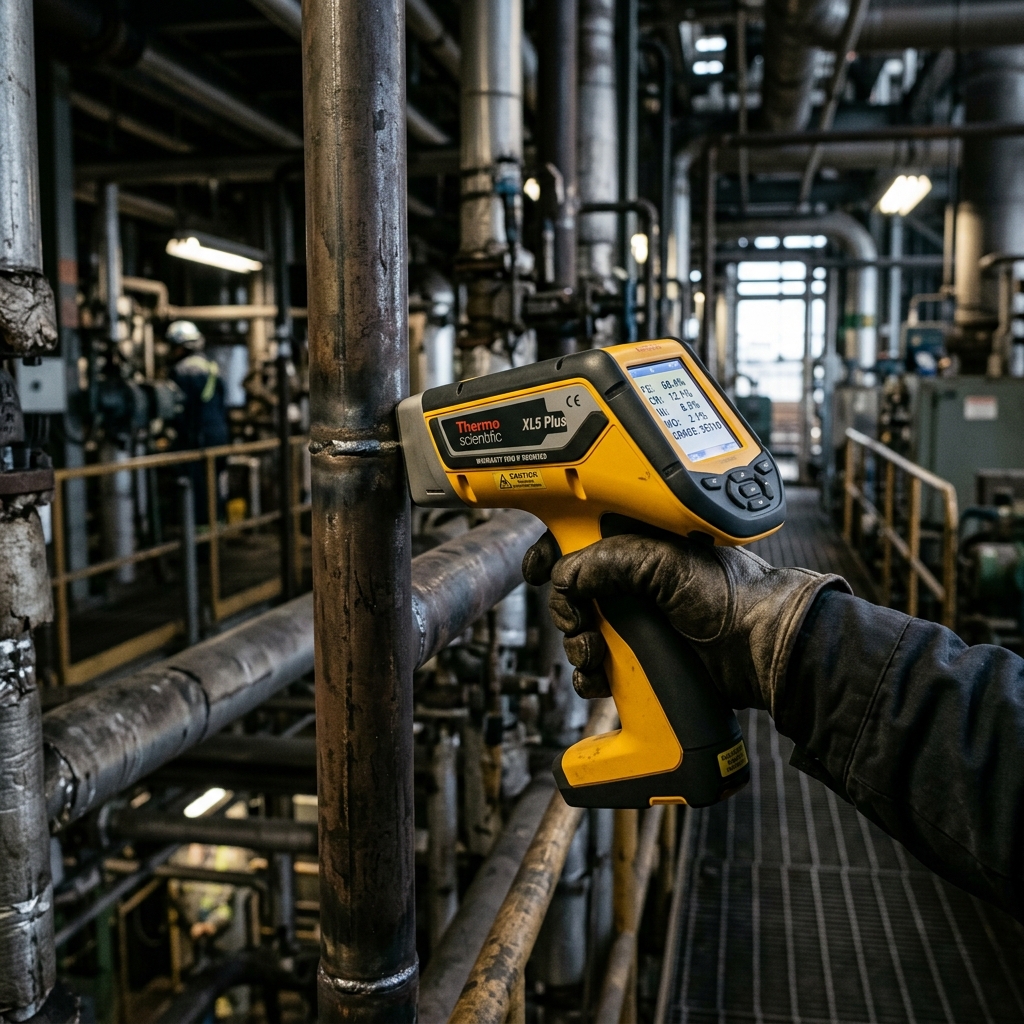
The Niton XL5 Plus handheld XRF enables in-situ analysis of trace chromium, copper, and molybdenum in carbon steel piping, allowing maintenance and inspection teams to assess material composition directly at difficult-to-access test points without cutting spools or removing components from service.
Application Study Data
Very good agreement between certified laboratory results and Niton XL5 Plus results in the presented comparison.
Total measurement time used for the reported Cr/Cu/Mo repeatability test.
Reliably detected in steel with appropriate sample preparation in the supplied study.

Note: Results are from the supplied FAC application study. Measurement performance depends on sample preparation, alloy matrix and test conditions.
Selecting the right instrument depends on elements of interest, analytical requirements, sample geometry, and whether your testing takes place on the shop floor, in the field, or at an inspection counter.
With over 22 years of specialized analytical experience, Rivora provides sample testing, on-site demonstrations, operator training, and technical support across India.