Technology / LIBSLaser-Induced Breakdown Spectroscopy

Laser-focused.
Carbon analysis.

Laser-Induced Breakdown Spectroscopy (LIBS) provides portable quantitative carbon measurement and alloy identification in steels. Calculate carbon equivalency, verify carbon-sensitive alloys, and assess weldability in approximately 10 seconds — without radioactive sources or heavy carts.

Carbon (C)Direct Measurement
~10sAnalysis Cycle
CECalculated Metric
~2.9 kgHandheld Portability
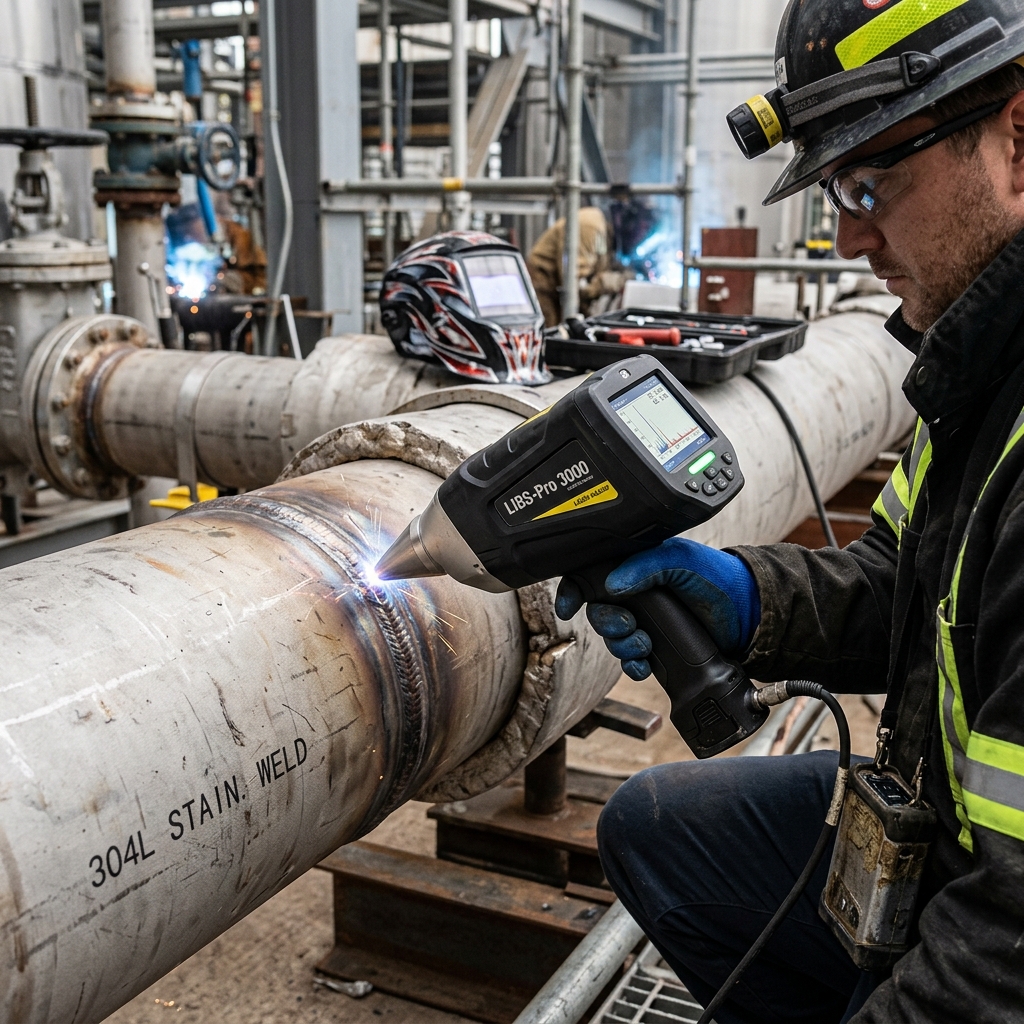
Niton Apollo handheld LIBS analyzer measuring carbon content on pipeline weld
Carbon Analysis · Alloy Identification · Carbon Equivalency
LIBS Analysis
Scientific Principle

How Handheld LIBS Generates Optical Plasma

LIBS focuses high-intensity laser pulses onto the metal surface, creating a micro-plasma that atomizes surface elements. As the plasma cools, excited atoms emit distinctive light wavelengths that are dispersed and quantified by an onboard high-resolution spectrometer.

Phase 01

Laser Interaction

A focused laser interacts with the sample surface to ablate a microscopic quantity of material.

Phase 02

Plasma Formation

The interaction creates a localized plasma containing excited atoms and ions from the sample.

Phase 03

Optical Emission

Light emitted from the plasma carries element-specific spectral information under an integrated argon purge.

Phase 04

Analysis & Result

The analyzer processes the spectral response to determine alloy composition, carbon content, and supported calculated metrics such as carbon equivalency.

Portfolio Positioning

Positioning LIBS Within Rivora's Portfolio

Within Rivora's supplied analyzer portfolio, handheld XRF serves broad elemental and alloy-analysis workflows, while Niton Apollo LIBS provides the carbon-analysis capability required for carbon-sensitive alloy and weldability applications.

Metallurgical Decision Support

The Carbon & Carbon Equivalency Workflow

Carbon is a critical element in ferrous metallurgy. Measuring carbon content in the field helps teams make timely decisions regarding alloy verification, weld procedure planning, and material traceability.

Decision Stage [01]

Carbon Measurement & Grade Differentiation

The Niton Apollo is designed for fast, low-detection-limit carbon analysis and alloy-grade identification in the field. Portable carbon measurement helps distinguish carbon-sensitive alloy grades and supports material verification.

Analytical ScopeCarbon Content & Alloy Identification
Decision Stage [02]

Carbon Equivalency for Weldability Assessment

Carbon equivalency provides a combined assessment of carbon and key alloying elements in steel. The analyzer calculates carbon equivalency from measured alloy chemistry to support grade identification and piping weldability assessment.

Weldability AssessmentThe analyzer calculates carbon equivalency from measured alloy chemistry to support grade identification and piping weldability assessment.
Calculated MetricIn-situ Carbon Equivalency (CE)
Decision Stage [03]

Material Verification & Quality Control

Carbon equivalency and alloy chemistry provide useful field data for piping weldability assessment. Field verification helps inspection teams confirm material chemistry before welding, fabrication, or modification.

Field Decision SupportMaterial verification before fabrication
Application Spectrum

Targeted Industrial Applications

From piping inspection to manufacturing verification, handheld LIBS provides fast field testing wherever carbon content and alloy verification are essential.

[01]Piping & Fabrication

Carbon & Low-Alloy Steel Verification

Field verification of piping and structural carbon steels where alloy chemistry and carbon content support material identification and weld procedure planning.

Analytical DecisionAlloy Chemistry & Carbon Verification
[02]Stainless Steels

Carbon-Sensitive Stainless Grade Verification

Verification of low-carbon and standard-carbon stainless alloy components to ensure the correct material grade is verified in service.

Analytical DecisionGrade Identification & Verification
[03]Inspection & NDT

In-Service Piping & Weldability Assessment

Direct testing on pipe spools, fittings, and components prior to welding or modification to support weld procedure selection.

Analytical DecisionAlloy Composition & CE Assessment
[04]Metals & Scrap

Tramp & Trace Element Screening

Detecting tramp and trace elements and helping prevent contaminated scrap from entering manufacturing and recycling supply streams.

Analytical DecisionTrace Element Screening
[05]Quality Assurance

Mill Test Report (MTR) Validation

Independent verification of incoming materials against mill test reports to confirm material chemistry prior to fabrication.

Analytical DecisionMTR Verification & QC Audit
[06]Recycling

Scrap Sorting & Contamination Prevention

Segregating alloy scrap to prevent carbon and alloy contamination in specialty recycling and manufacturing streams.

Analytical DecisionAlloy & Carbon-Grade Sorting
Thermo Scientific Niton Apollo handheld LIBS analyzer in field inspectionHandheld LIBS Platform
Analytical TechnologyLaser-Induced Breakdown Spectroscopy (LIBS)
Laser SourceClass 3B Solid-State Laser (1064 nm)
Purge GasIntegrated Argon Canister (Quick-Disconnect)
Analysis TimeApproximately 10 Seconds per Reading
Reported ParametersCarbon Content, Carbon Equivalency & Alloy Composition
Aiming & AlignmentDual Integrated Micro and Macro Cameras
Featured LIBS Platform

Niton Apollo Handheld LIBS

Field carbon measurement and alloy identification in a portable handheld form factor.

The Niton Apollo is engineered for fast, field-ready carbon measurement and alloy analysis. Featuring an integrated argon gas canister and a tapered nose designed to access difficult test locations such as narrow weld bevels, the Apollo delivers carbon content and carbon equivalency data directly at the pipe spool, fabrication bay, or scrap yard.

  • Fast quantitative carbon analysis with low detection limits
  • Integrated miniature argon canister system
  • Dual macro and micro cameras for exact test positioning
  • Hot-swappable batteries for extended field operation
  • WiFi, Bluetooth & USB data export for report generation
  • Tapered nose cone to reach difficult test geometries
Consultation & Support

Need to Measure Carbon in the Field?

Rivora provides comprehensive technical support for LIBS applications across India — including sample testing on your specific steel grades, live on-site demonstrations, operator training, and ongoing technical support.